
Introduction to Pharmacognosy
by Dr. Subodh Kumar Dubey & Abhinav Kumar Bhaskar & Ashutosh Bansal & Vipin Sharma
₹250
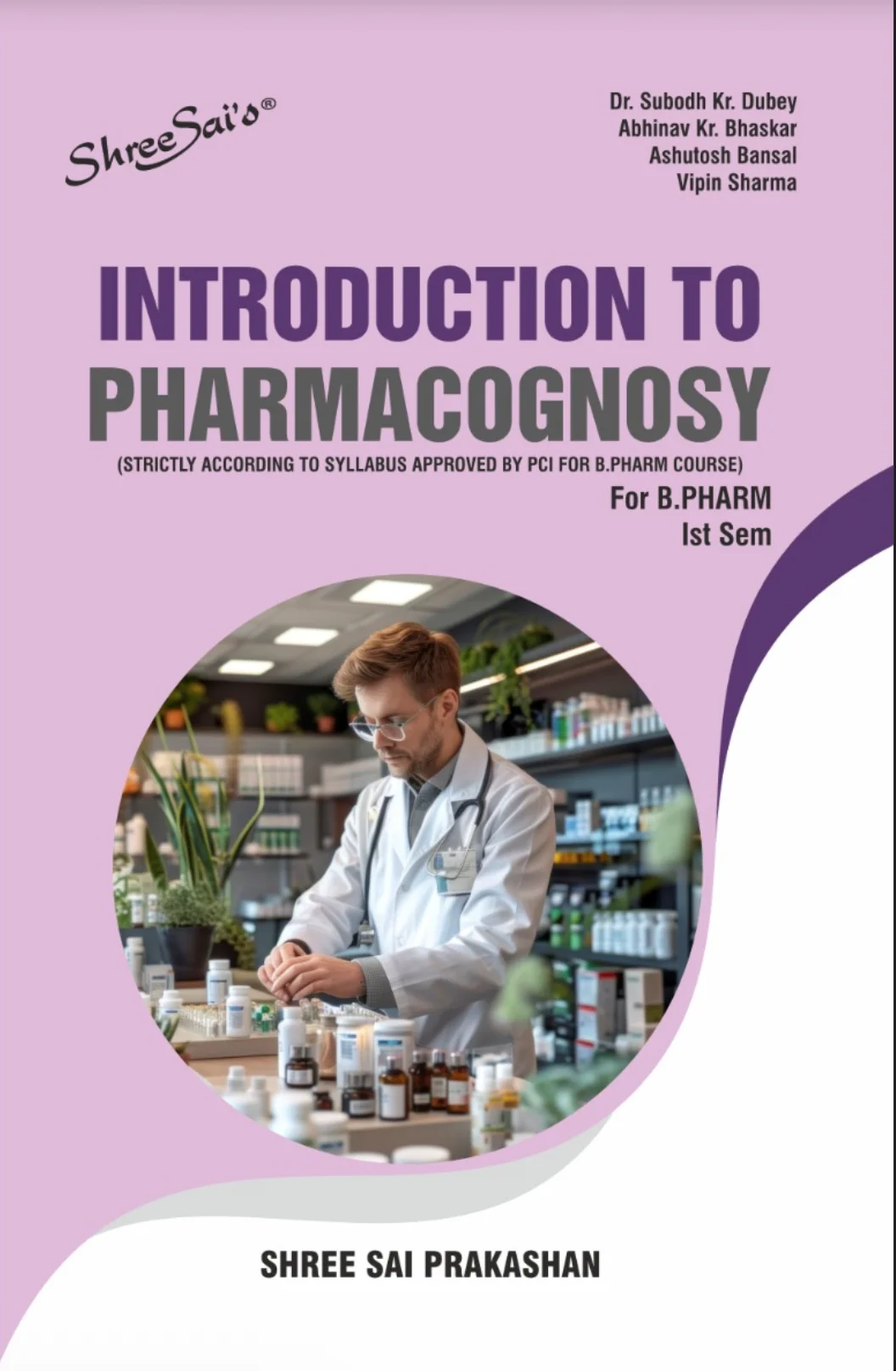
As per PCI NEP 2020 · Free Unit 1 sample to read before you buy
Why this book
- Strictly as per PCI NEP 2020 (BP105T): all five units in the official syllabus order.
- The full foundation: definition, history and scope of pharmacognosy, sources of drugs and the classification of crude drugs.
- Quality from field to shelf: cultivation, collection, processing and storage (WHO GAP/GCP) and the quality control and evaluation of crude drugs, including DNA barcoding.
- Plant metabolites and phyto-therapeutics: alkaloids, glycosides, flavonoids, tannins, terpenoids and volatile oils, and major herbal drug classes (adaptogens, hepatoprotectives, antidiabetics and more).
- The AYUSH and TCM traditional systems of medicine, as required by the NEP syllabus.
About this book
Introduction to Pharmacognosy (BP105T) opens the B.Pharm student’s study of drugs of natural origin, and this textbook presents it exactly as the PCI NEP 2020 syllabus prescribes, unit by unit, so what students study matches what their university examines.
The book covers the fundamentals of pharmacognosy (definition, history, scope, sources of drugs and the systems for classifying crude drugs); cultivation, collection, processing and storage under Good Agricultural and Collection Practices; the quality control of drugs of natural origin (adulteration, evaluation, physicochemical parameters and DNA barcoding); primary and secondary plant metabolites together with the AYUSH and TCM traditional systems of medicine; and the phyto-therapeutic agents — the biological source, constituents and uses of major herbal drug classes such as adaptogens, hepatoprotectives, cardiovascular drugs, antidiabetics and anti-inflammatories.
Explanations are kept clear and the drug lists organised so students can revise efficiently before exams. Led by Dr. Subodh Kumar Dubey with Abhinav Kumar Bhaskar, Ashutosh Bansal and Vipin Sharma, and published by Shree Sai Prakashan, Meerut, for B.Pharm First Year students at every PCI-approved institution.
Syllabus coverage · PCI NEP 2020 BP105T
See the full BP105T syllabus →Unit 1 · Fundamentals of Pharmacognosy 10 hrs
Definition, history, scope and development of pharmacognosy; sources of drugs (plant, animal, microbial, marine, mineral and tissue culture); milestones in drug discovery (morphine, quinine, aspirin, penicillin, taxol, artemisinin); herbal pharmacopoeias; and the classification of crude drugs (alphabetical, morphological, taxonomical, chemical, pharmacological and chemotaxonomic).
Unit 2 · Cultivation, Collection, Processing & Storage 8 hrs
Methods of cultivation and Good Agricultural and Collection Practices (WHO / GAP / GCP); factors influencing cultivation, collection and storage; plant hormones, polyploidy, mutation and hybridization; and ex-situ and in-situ conservation and eco-pharmacognosy for endangered medicinal plants.
Unit 3 · Quality Control of Drugs of Natural Origin 8 hrs
Adulteration and the evaluation of crude drugs by organoleptic, microscopic, physical, chemical and biological methods; physicochemical parameters (extractive values, moisture, ash values, bitterness, foaming and swelling index, optical rotation, acid and saponification value); and DNA barcoding.
Unit 4 · Plant Metabolites & Traditional Systems of Medicine 12 hrs
Primary and secondary plant metabolites — carbohydrates, proteins, lipids, alkaloids, glycosides, flavonoids, tannins, terpenoids, volatile oils and resins; and the basic principles, dosage forms and role of the AYUSH and TCM traditional systems of medicine.
Unit 5 · Phyto-therapeutic Agents 7 hrs
Biological source, constituents and uses of major herbal drug classes — adaptogens (Ashwagandha, Tulsi), hepatoprotectives (Milk thistle, Kutki), cardiovascular drugs (Garlic, Arjuna), antidiabetics (Gymnema, Fenugreek), anti-inflammatories (Turmeric, Boswellia), and CNS, antimicrobial and other agents.
About the authors
Dr. Subodh Kumar Dubey — Professor & Dean, School of Pharmacy, Vikrant University, Gwalior
Abhinav Kumar Bhaskar — Associate Professor, School of Pharmacy, Vikrant University, Gwalior (M.P.)
Ashutosh Bansal — M.Pharm — Assistant Professor, School of Pharmacy, Vikrant University, Gwalior (M.P.)
Vipin Sharma — M.Pharm — School of Pharmacy, Vikrant University, Gwalior (M.P.)
Related tags
Buying for a college?
We supply Introduction to Pharmacognosy and the complete B.Pharm First Year set to colleges and libraries at institutional pricing.
WhatsApp for a bulk quote

Studying D.Pharma instead? See the D.Pharma series →