Polytechnic Mathematics-I
by Dr. D.C. Agarwal & Dr. Pradeep K. Joshi & Dr. Pooja Agarwal · About the author →
₹170
About this book
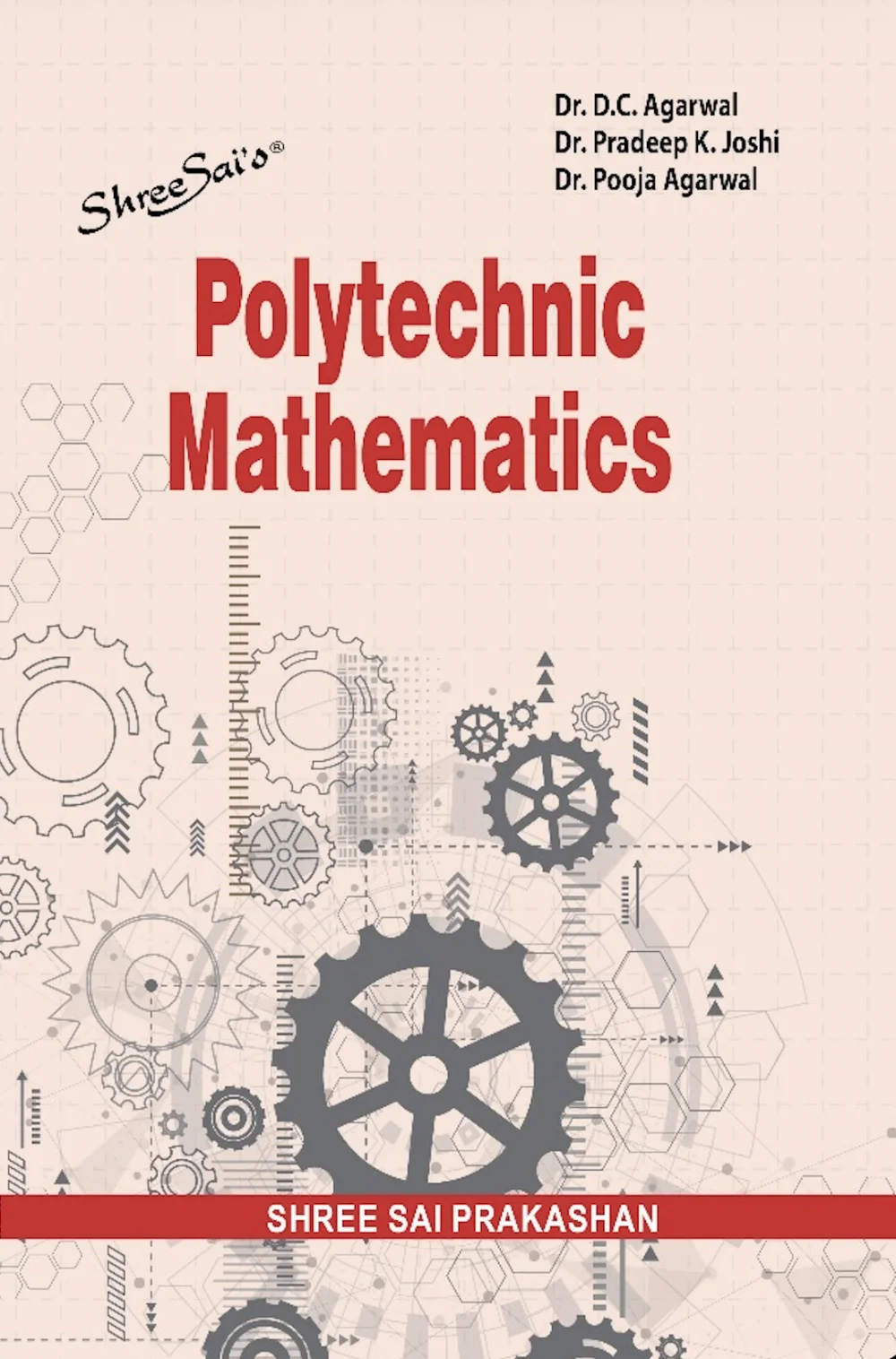
Polytechnic Mathematics-I by Dr. D.C. Agarwal, Dr. Pradeep K. Joshi and Dr. Pooja Agarwal is written strictly to the AICTE-based OCBC 2023 diploma curriculum of Rajiv Gandhi Proudyogiki Vishwavidyalaya (RGPV), Bhopal — the First Semester Mathematics-I paper (code 7350), covering all three prescribed units in the exact order the university examines them.
The three units — Trigonometry (angles and their measurement, T-ratios of allied and multiple angles, sum, difference and product formulae), Differential Calculus (limits and the two standard limits, differentiation by first principles, product, quotient and chain rules, logarithmic and exponential differentiation) and Algebra (complex numbers and De Moivre's theorem, partial fractions, permutations and combinations, and the binomial theorem) — are each explained with worked examples and practice problems, with the question-paper blueprint kept in view.
Built on the AICTE national model diploma curriculum, so it also suits first-semester diploma students under other AICTE-aligned state boards. Published by Shree Sai Prakashan, Meerut. Also available in Hindi as पॉलिटेकिनक गणित.
Syllabus coverage
See the full Paper 7350 syllabus →Unit 1 · Trigonometry
Concept and measurement of angles in degrees, grades and radians and their conversion; T-ratios of allied angles; sum, difference and product formulae; T-ratios of multiple angles (2A, 3A).
Unit 2 · Differential Calculus
Definition of a function; concept of limits and the two standard limits; differentiation by definition of xⁿ, sin x, cos x, tan x, eˣ and logₑx; differentiation of sums, products, quotients and functions of a function; differentiation of trigonometric functions; logarithmic and exponential differentiation.
Unit 3 · Algebra
Complex numbers — real and imaginary parts, polar and Cartesian forms and conversion, conjugate, modulus and amplitude, algebra of complex numbers, De Moivre's theorem; partial fractions (non-repeated linear factors); permutations and combinations (nPr, nCr); binomial theorem for a positive integral index and the middle term.