
Anna University R2025 Maths Syllabus — which book covers which course
Anna University, Chennai — Regulations 2025 (R2025)
Anna University, Chennai is the affiliating technical university for Tamil Nadu, with hundreds of affiliated engineering colleges. Its Regulations 2025 (R2025) curriculum applies to the 2025-26 batch onward and introduced a new mathematics course structure with MA25 course codes.
We read all 53 published R2025 programme curricula: between them they use just eleven distinct mathematics courses, so the map below is organised by course. Applied Calculus and Linear Algebra are taken by almost every programme; the rest are branch-specific.
Taken by almost every programme
Applied Calculus appears in 50 of the 53 R2025 programmes and Linear Algebra in 46 — across Civil, Mechanical, CSE, ECE, EEE and the Technology faculties alike. If you are a first-year Anna University student, these two are almost certainly your maths papers.
Applied Calculus
4 credits · 3L–1T–0P · BS — Basic Science (Mathematics) · Semester 1 · 50 of 53 programmes
- Differential Calculus — functions and their graphs, limits and continuity, limits at infinity, the derivative as a function, maxima & minima of single-variable functions, mean value theorem, effect of derivatives on the shape of a graph
- Functions of Several Variables — partial derivatives, chain rule, total derivative, maxima & minima of functions of two variables, method of Lagrange’s multipliers, engineering application problems
- Integral Calculus — fundamental theorem of calculus, indefinite integrals and the net change theorem, improper integrals, arc length, area of a region, area of a surface of revolution
- Multiple Integrals — iterated integrals and Fubini’s theorem, evaluation of double integrals, change of order of integration, change of variables between Cartesian and polar coordinates, triple integrals with cylindrical and spherical coordinates
Linear Algebra
4 credits · 3L–1T–0P · BS — Basic Science (Mathematics) · 46 of 53 programmes
- Vector Spaces — subspaces, linear combinations, span, generating sets, linear dependence & independence, basis and dimension, dimension of subspaces
- Linear Transformations and Diagonalization — null space, range, dimension theorem, matrix representation of a linear transformation, eigenvalues & eigenvectors, diagonalizability
- Inner Product Spaces — inner product, norms, Cauchy–Schwarz inequality, Gram–Schmidt orthogonalization
- Matrix Decomposition — orthogonal transformation of a symmetric matrix to diagonal form, positive definite matrices, QR decomposition, singular value decomposition (SVD), least-squares solutions
Engineering & Technology streams
Computational Differential Equations is taken by 23 programmes and Probability & Statistics by 19 — spanning Civil, Mechanical, Aeronautical, Chemical, Biotech, Textile and the CS streams. Both courses are explicitly computational, expecting work in R/Python or open-source maths software.
Computational Differential Equations
4 credits · 3L–1T–0P · BS — Basic Science (Mathematics) · 23 of 53 programmes
- First Order Ordinary Differential Equations — formation from physical problems, variables separable, exact equations, Leibnitz’s and Bernoulli’s equations; numerical solution by Euler’s formula, Taylor series and fourth-order Runge–Kutta
- Higher Order Ordinary Differential Equations — linear equations of second and higher order with constant coefficients, Euler’s linear equations, method of variation of parameters; numerical solution by Runge–Kutta and finite-difference methods
- First Order Partial Differential Equations — formation by elimination of arbitrary constants and functions, solution by variable separable method, standard types, Lagrange’s linear equation; numerical solution by the method of lines
- Higher Order Partial Differential Equations — linear homogeneous PDEs of second and higher order with constant coefficients; finite-difference solution of two-dimensional Laplace and Poisson equations, one-dimensional heat equation by Bender–Schmidt and Crank–Nicolson schemes, and the wave equation by an explicit scheme
Probability and Statistics
4 credits · 3L–1T–0P · BS — Basic Science (Mathematics) · 19 of 53 programmes
- Descriptive Statistics — collection, classification and tabulation of data, bar and pie charts, measures of central tendency (mean, median, mode), measures of variation (range, quartile deviation, standard deviation, coefficient of variation), five-number summary and box plots
- Probability and Random Variables — axioms of probability, conditional and total probability, Bayes’ theorem, distribution functions, probability mass & density functions, moments, and the binomial, Poisson, normal, uniform and exponential distributions
- Two-Dimensional Random Variables — joint, marginal and conditional distributions, expected values of functions of two variables, correlation and regression, central limit theorem
- Testing of Hypothesis — large-sample tests for a single mean and difference of means, small-sample t and F tests (paired t-test, variance ratio test), chi-square tests for independence of attributes and goodness of fit
- Design of Experiments — analysis of variance (ANOVA), completely randomized design (CRD), randomized block design (RBD) and Latin square design (LSD)
Computer Science streams
Discrete Mathematics is the CS-specific paper, taken by all ten computing programmes — CSE, IT, AI & DS, CSBS, Computer & Communication, CSE (Data Science / IoT / Cyber Security / AI & ML) and Computer Science & Design. R2025 frames it around AI and algorithmic reasoning.
Discrete Mathematics
4 credits · 3L–1T–0P · BS — Basic Science (Mathematics) · 10 computing programmes
- Set Theory, Relations and Functions — inductive definition of sets and proof by induction, Peano postulates, equivalence relations and partitions, injective/surjective/bijective functions, composition and inverse functions, permutation functions, recurrence relations and solving linear recurrences
- Logic — propositions, logical operators, normal forms, rules of inference, consistency, propositional logic and proofs, predicates and quantifiers, universe of discourse, logical equivalences for quantified statements, rules of specification and generalization, validity of arguments
- Boolean Algebra and Lattice Theory — partial ordering, posets, lattices as posets and as algebraic systems, properties of lattices, sublattices, direct product and homomorphism, Boolean algebra and Boolean homomorphism
- Graph Theory — types of graphs, matrix representation, graph isomorphism, walks, paths and cycles, Eulerian and Hamiltonian graphs, planar graphs, Euler’s formula, and Dijkstra’s shortest-path algorithm
Electrical & Electronics streams
The EEE, ECE, Instrumentation, VLSI, Biomedical and Medical Electronics programmes take specialised transform, matrix and random-process papers instead of the general courses. (Two further courses, MA25102 and MA25201, appear only in the EEE Training-Integrated programme.)
Transforms and its Applications
4 credits · 3L–1T–0P · BS — Basic Science (Mathematics) · EEE, Electrical & Computer, Electronics & Instrumentation, Instrumentation & Control
- Laplace Transforms — existence conditions and properties, transforms of standard functions, derivatives and integrals, unit step and Dirac delta functions, transforms of periodic functions, inverse Laplace by partial fractions and the convolution theorem, solution of second-order ODEs
- Z-Transform — Z-transform of standard functions and its properties, inverse Z-transform by standard functions, partial fractions and convolution, and the solution of difference equations
- Fourier Series — Dirichlet’s conditions, general Fourier series and its convergence, odd and even functions, half-range sine and cosine series, root mean square value, Parseval’s identity, application to the one-dimensional wave and heat equations
- Fourier Transform — complex Fourier transform and its properties, and its relation to the other transforms
Matrices for Engineers
4 credits · 3L–1T–0P · BS — Basic Science (Mathematics) · EEE, Electrical & Computer, Electronics & Instrumentation, Instrumentation & Control
- Matrices — characteristic equation, eigenvalues & eigenvectors of a real matrix and their properties, Cayley–Hamilton theorem and its applications, orthogonal matrices
- Quadratic Forms — orthogonal transformation of a symmetric matrix to diagonal form, nature of quadratic forms, reduction to canonical form by orthogonal transformation
- Advanced Decompositions — matrix norms, Jordan normal form, QR decomposition, singular value decomposition (SVD) and least-squares solutions
Probability, Statistical and Random Processes · Probability and Random Processes
4 credits · 3L–1T–0P · BS — Basic Science (Mathematics) · ECE, Electronics & Computer, VLSI (C11) · Biomedical, Medical Electronics (C12)
- Descriptive and Bivariate Statistics — mean, median, mode, variance and standard deviation, coefficient of variation, covariance and correlation coefficient, linear regression by least squares
- Probability Foundations — axioms, conditional probability and Bayes’ theorem, discrete and continuous random variables, moments and moment generating functions
- Standard Distributions — binomial, Poisson and geometric; uniform, exponential and normal; functions of random variables
- Two-Dimensional Random Variables — joint, marginal and conditional distributions, covariance, correlation and linear regression, transformation of random variables
- Random Processes — stationarity, autocorrelation and the stochastic-process foundations used in signal processing and communication systems
Every title in the Anna University map
Affordable, Indian-authored engineering mathematics — written to the same topics R2025 sets, whichever branch and whichever affiliated college.
Engineering Mathematics-I
View details
Introduction to Discrete Structure & Linear Algebra
View details
Engineering Mathematics-II
View details
Engineering Mathematics-III
View details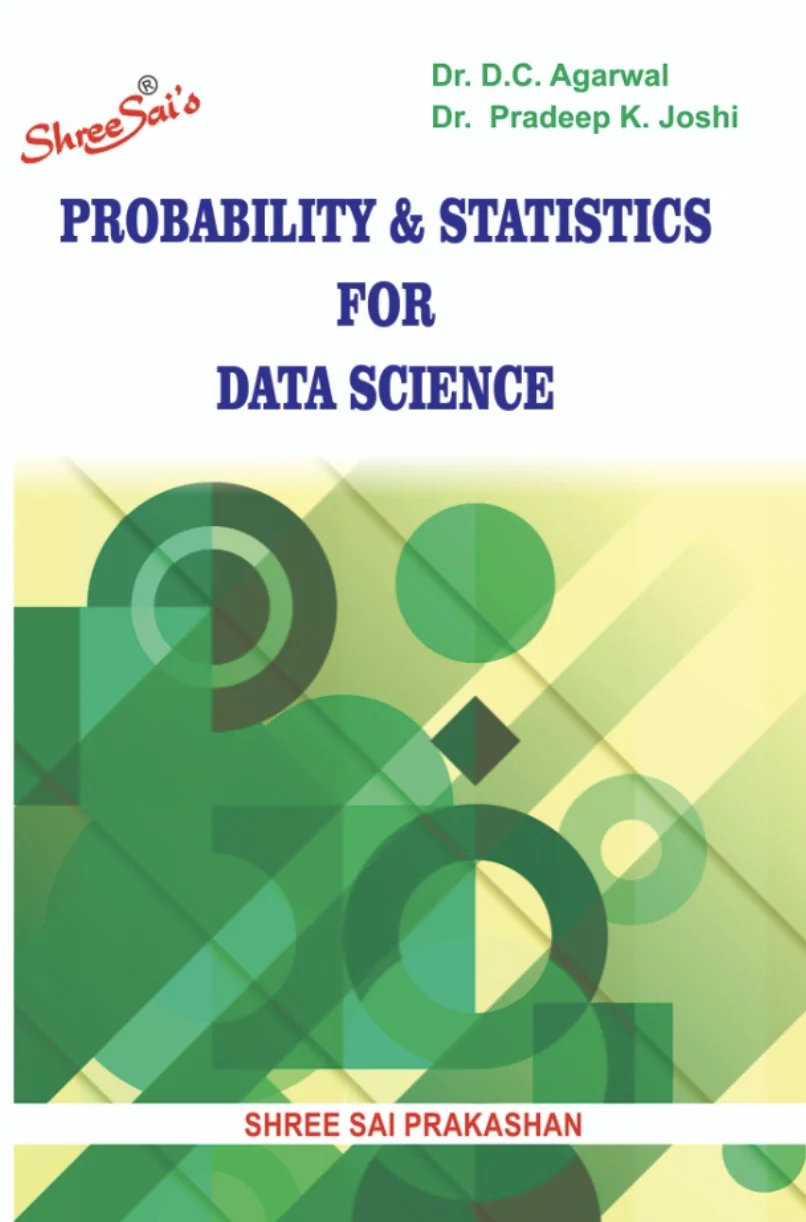
Probability & Statistics for Data Science
View details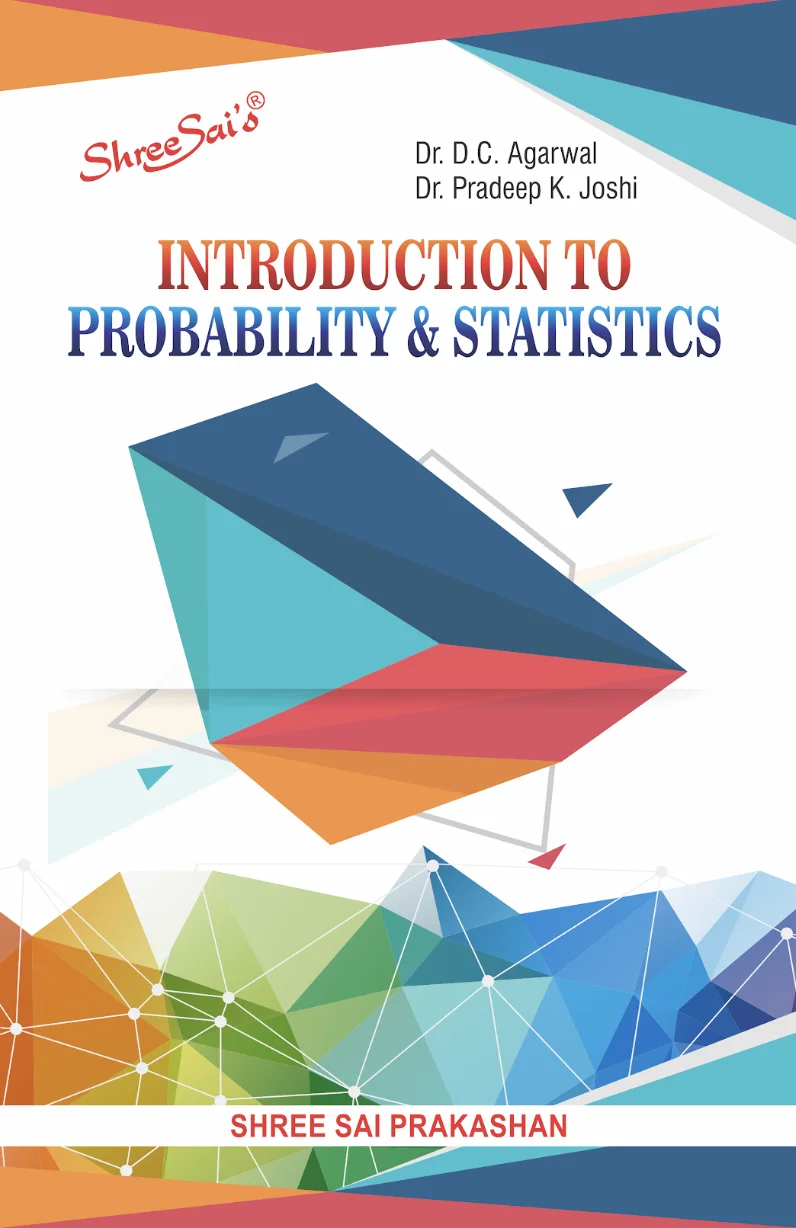
Introduction to Probability & Statistics
View details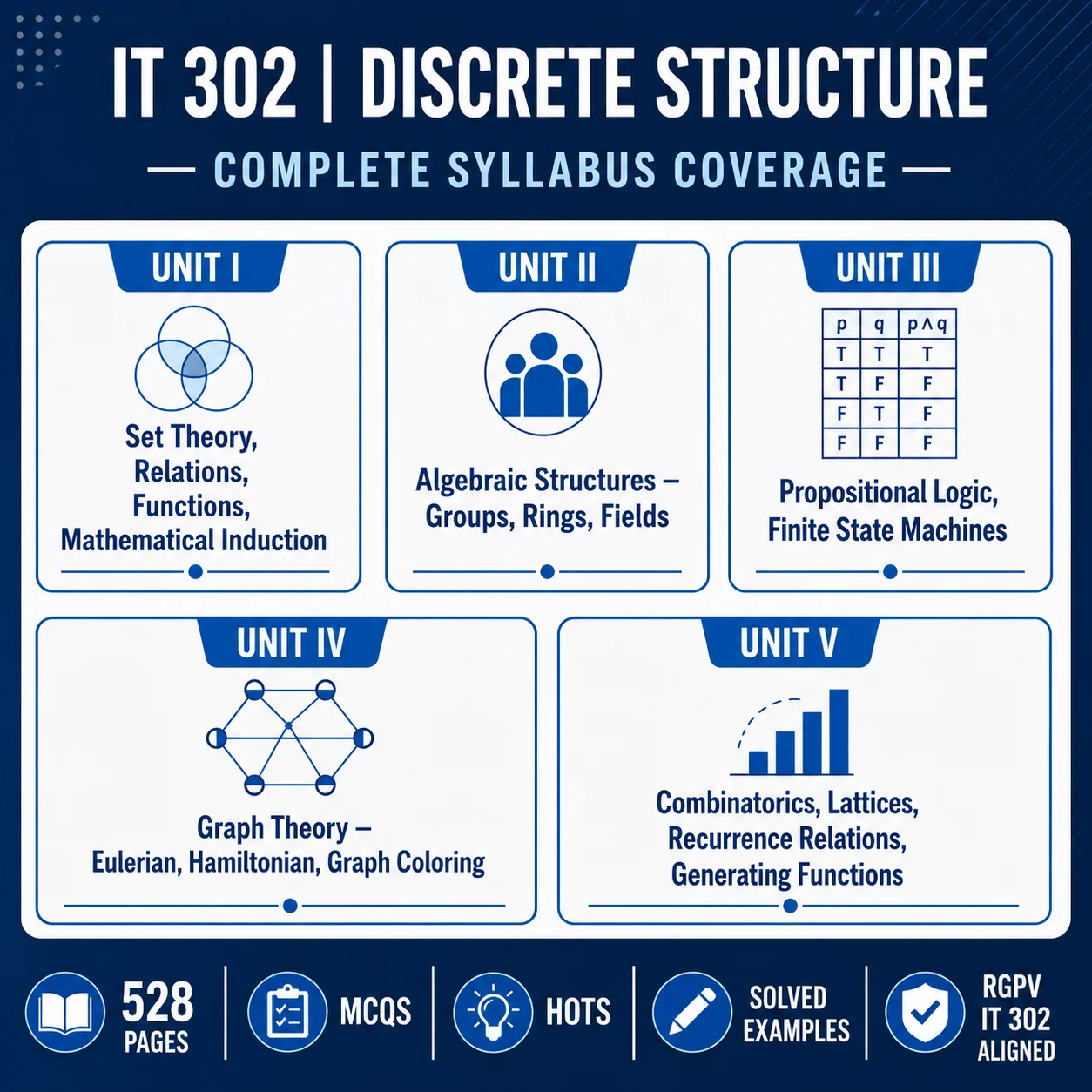
Discrete Structure
View details